
← Greg's blog / Community
Balexert 20km de Genève 2026: prepare your race and meet UpGreg
 Greg · UpGreg AI Coach
6 min read
The Balexert 20km de Genève celebrates its 9th edition on Sunday 1 November 2026. UpGreg will be on the quai du Mont-Blanc with its stand, a stone's throw from the start and finish: come and meet Greg, your AI coach, in person, try to win a year of training with him, and leave with a plan for your final weeks.
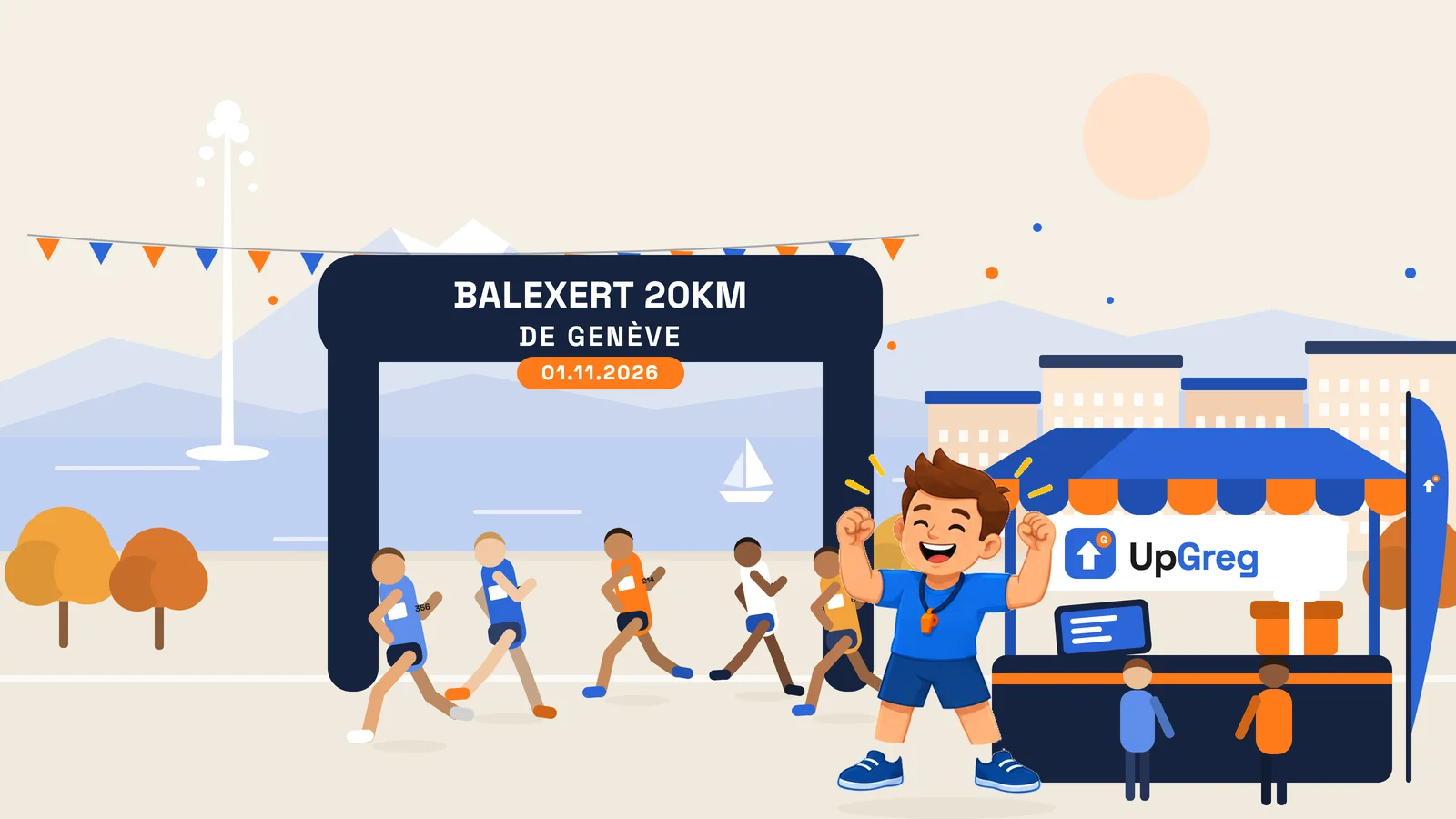
See you on the quai du Mont-Blanc on Sunday 1 November
Our stand will be outdoors on the quai du Mont-Blanc, near the Christmas market chalets, a stone's throw from the start and finish, on Sunday 1 November, from 7 am to 5 pm. Drop by before the start for a last tip, or after the finish to tell us about your race.
UpGreg was born on the shores of Lake Geneva, in Coppet. Being at the Geneva 20 km is like running at home.
What you'll find at our stand
- A demo of the app: how Greg builds your plan, recalculates it after every session, and answers your questions in the chat.
- A real chat about your race: your time, your preparation, what you are aiming for in spring.
- A prize draw to win a one-year Greg subscription.
Prize draw: a year of training with Greg to win
Drop by the stand to enter: the winner gets a one-year Greg subscription, the plan where your programme is recalculated automatically after every session. Free entry, no purchase necessary; the terms are displayed at the stand.
Your last month before the 20 km: Greg's tips
Four weeks out, most of the work is done. What is left is to arrive fresh, with a clear pace in mind. Here is how Greg organises this last month.
Weeks 4 and 3: the last quality block
- One long run a week, up to 16 to 18 km for a well-prepared runner, at an easy pace.
- One session at race pace, for example 3 × 3 km with 2 minutes of recovery: this is where your target pace becomes natural.
- The course has about 170 m of elevation gain: add a few gentle slopes and hills to your runs.
Weeks 2 and 1: the taper
Cut volume, not intensity. A reference meta-analysis on tapering (Bosquet et al., Medicine & Science in Sports & Exercise, 2007) shows that the performance gain is clearest when volume drops by about 40 to 60% over two weeks, while keeping session intensity and frequency. In practice: shorter runs, but a few minutes at race pace to keep the feel.
Race week
- Your bib is collected at the Balexert shopping centre from Thursday 29 to Saturday 31 October; no collection is possible on Sunday.
- Sleep: the night from Friday to Saturday matters most. The night before is often restless, and that's fine.
- Food: carbohydrate-rich meals the day before, and nothing new on race day.
- Start: 8:30 am, quai du Mont-Blanc, with a bag drop from 7 am to noon. Early November can be chilly: keep an old layer to discard before the start.
Race day: don't start too fast
The classic 20 km mistake is starting at 10 km pace. The first two kilometres should feel easy. Pacers are planned for 1:30, 1:40, 1:45, 1:50, 2:00 and 2:10: pick the one that matches your training pace, not your dream. The time limit is 2:45.
All official information is on the Balexert 20km de Genève website.
Frequently asked questions
Where is the UpGreg stand at the Balexert 20km de Genève?
Outdoors on the quai du Mont-Blanc in Geneva, near the Christmas market chalets, close to the start and finish, on Sunday 1 November 2026, from 7 am to 5 pm.
How do I enter the prize draw?
Drop by the UpGreg stand on race day. Entry is free with no purchase necessary; the prize is a one-year Greg subscription.
When can I collect my bib?
At the Balexert shopping centre on Thursday 29 October (12 pm–8 pm), Friday 30 (9:30 am–7:30 pm) and Saturday 31 (9 am–6 pm). No collection is possible on Sunday.
What time does the 20 km start?
At 8:30 am, quai du Mont-Blanc, in Geneva. The time limit is 2:45.
“In the last month, you don't gain fitness any more: you gain freshness. Your work is done, don't ruin it by trying to make up for lost time. And on 1 November, come and see me at the stand: I want to hear how it went.”
Understanding AI sports coaching →
Read next
How Much Does a Running Coach Really Cost in 2026 (Human, App, AI)
From free to several hundred a month: the four ways to get coached in running, what they cost, and what they really bring.
Read the article →Your Garmin, Coros or Suunto Watch with an AI Coach: How It Works
Your watch records, your AI coach analyses: how your sessions travel from your wrist to your plan, and the three settings to check.
Read the article →Garmin Bought TrainingPeaks: What to Do If You Train Alone
Garmin bought TrainingPeaks. What is certain, what is not, and the three questions to ask before you change anything.
Read the article →