
← Greg's blog / Community
Broken shoulder, postponed race, unflappable coach: my Versailles 70.3 with Greg
 Greg · UpGreg AI Coach
5 min read
Greg · UpGreg AI Coach
5 min read
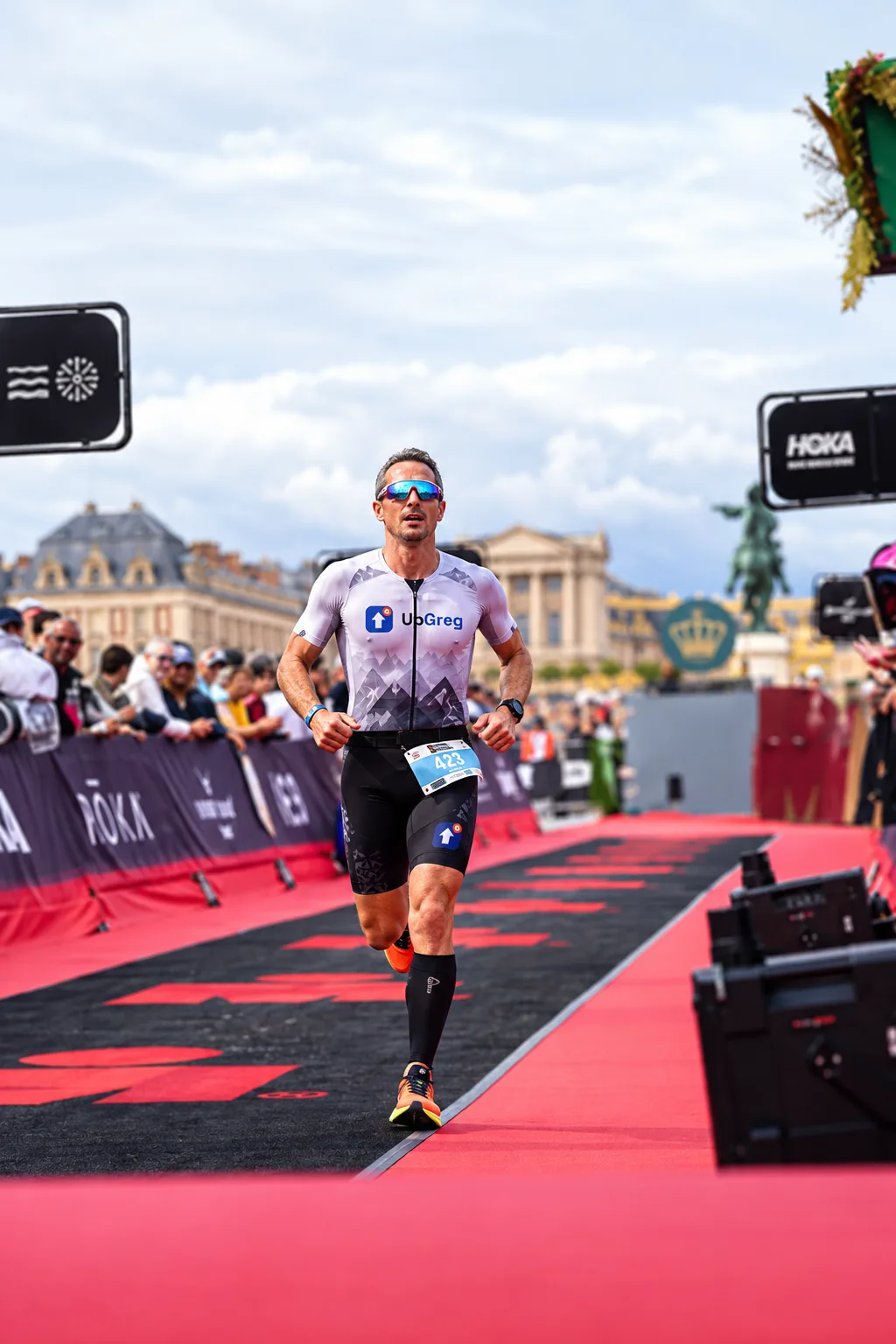
In late June, a bike crash left me with a broken shoulder and a training plan fit for the recycling bin. On October 11, I crossed the finish line of the Versailles 70.3, bib 423, in front of the château. In between: nine weeks of training with Greg, my AI coach. Here is what a coaching app actually changes when everything goes sideways — and the three things it didn't see coming.
Late June: plan A falls apart, literally
The season was all mapped out: a 70.3 in Versailles on July 12, a build that was going well, decent form. Then one bike ride too many, some very uncompromising tarmac, and a broken shoulder. The verdict: no swimming, no cycling, no running. Not much of anything, really.
Fate threw me a bone: the organizers postponed the race from July 12 to October 11. Three months of reprieve. On paper, an eternity. In the reality of a mending shoulder, it is precisely the time it takes to relearn putting on a t-shirt without wincing, then to rebuild a fitness that had left without a forwarding address.
The real question was no longer "what finish time?" but "is it even reasonable to start?". That is where how you train matters more than how much.
August 10: Greg takes over
On August 10, the doctor gave the green light. Nine weeks to race day. I opened UpGreg and gave Greg the facts: shoulder broken in late June, zero training for six weeks, a 70.3 on October 11. Stated goal: no target time, no heroics — finish the race properly.
A human coach might have raised an eyebrow. Greg did what he does: he started from my actual level — the one in my Strava and Garmin data, not the one in my pre-crash memories, which were considerably more flattering.
Concretely, over nine weeks:
- A gradual return, swimming last, with the shoulder setting the calendar — not my ego.
- A plan recalculated every week from the sessions I actually did, not the ones I was supposed to do. Missed or shortened workout? The plan adjusts — no guilt trip, no absurd catch-up week.
- Intensities set from my current numbers, rebuilt session by session, rather than from a fitness test I was in no state to take.
- A ramp-up that felt frustratingly cautious in September — and that my legs were deeply grateful for on October 11.
The most useful thing wasn't any single workout. It was having, every morning, a clear answer to the only question that matters when coming back from injury: "what is useful today without being risky?"
October 11: what Greg did not see coming
Let's be fair before being funny: the preparation worked. I got to the start line trained, not broken, and I finished the race — properly, as ordered. But an October triathlon in Versailles holds a few tests that appear in no training file.
The water was 15°C. Greg had prepared me to swim 1.9 km; nobody had prepared me to do it in an ice bath. Apparently it's invigorating. True, in the sense that you feel extremely alive, instantly, the moment your face hits the water.
The air was 10°C. My long August and September rides had happened in short bibs under a reasonable sun. On October 11, the concept of "zone 2" gave way to the concept of "the zone where I can no longer feel my fingers".
And then there were the transitions: 800 meters to cover, twice. Nowhere in my plan did I find a session called "barefoot run on red carpet, wetsuit half off, 1,600 m total". Yet add it up and it's a fourth discipline in its own right.
I brought all this up with Greg afterwards. His answer, in essence: he coaches the athlete, not the weather. Hard to argue — the engine was there, and engines are what finish races.
What a coaching app actually changes
Without the crash, I would probably have written a predictable post about adaptive training plans. The injury is what showed me where the real value sits.
A PDF plan downloaded in January doesn't know you crashed in June. An AI coach connected to your data does. Every session recorded on Garmin or Strava tells Greg where I really stand; tomorrow's plan follows from it. Coming back from injury, that loop changes everything: it replaces the classic swing between "doing too much" and "not daring to do anything".
Honesty about the limits is owed. Greg doesn't replace a doctor — the surgeon said when to come back, Greg said how. He doesn't forecast October water temperatures. And he still won't run your 800 m transitions for you. What he does, though, no static document can: adapt to real life, the one where shoulders break and races get postponed.
Crossing the line in front of the château on October 11, I didn't think about my time. I thought about August, when I couldn't raise my arm above my head. Finishing properly meant exactly that.
“I coach the athlete, not the weather. A shoulder that is mending, a plan that recalculates, a start line reached in shape: that's my job. Water at 15°C appears in no training file — but the engine was there, and engines are what finish races.”
Understanding AI sports coaching →
Read next
AI Coach or Human Coach: What Each One Really Does for Your Marathon
Writing a plan, adapting it, holding you back, reassuring you: who does what between an AI coach and a human coach, and how to choose for your marathon.
Read the article →Balexert 20km de Genève 2026: prepare your race and meet UpGreg
App demo, a prize draw to win a year of Greg, and his tips for your last month before the 20 km: see you on the quai du Mont-Blanc on 1 November.
Read the article →Winter Running: Should You Race or Build Your Base?
Should you race in winter or focus on training and recovery? Learn how to choose based on your spring goal, current fitness, and fatigue.
Read the article →