
← Greg's blog / Training science
Ski conditioning: our matrix, and the 53 studies behind it
 Greg · UpGreg AI Coach
9 min read
Greg · UpGreg AI Coach
9 min read
Most 'ski prep' programs boil down to six exercises, identical for everyone: squat, lunges, wall sit, planks. Except that a slalom racer, a mogul skier at 182 beats per minute, a ski tourer on a three-hour skin track and a Sunday skier on groomed pistes have almost nothing in common — apart from the word 'ski'. So instead of a program, we built a matrix. Here is how, from what, and where it stops.
The wrong question: 'which exercises for skiing?'
Until you answer which skiing, for whom, and what's missing, a list of exercises is just an opinion. Three numbers make the point. In alpine skiing, ground forces reach five times body weight (Gilgien et al., Front Physiol 2019). In moguls, mean heart rate sits around 182 bpm with lactate at 7.6–8.6 mmol/L (Nakazato et al. 2019): a clearly anaerobic profile. In ski mountaineering, minimal energy cost is 10.6 J/kg/m at 3.5 km/h on a 21% slope (Tosi et al. 2010): pure aerobic. Three sports, three engines, three preparations.
That's the starting point of the matrix: cross what the discipline demands with what the athlete already has, and only allocate volume to the gap between the two.
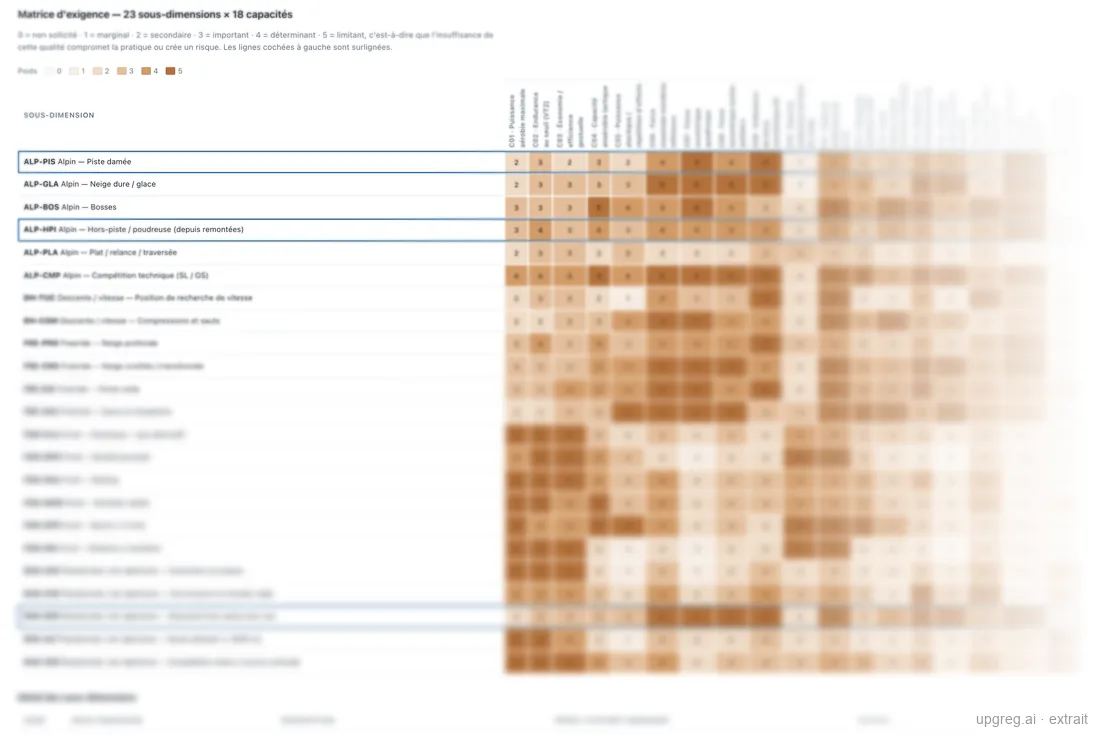
Twenty-three skis, not one
Each discipline is broken into sub-dimensions, because that's where demands actually diverge — not at sport level. A few things the literature gives, and the matrix encodes:
- Alpine. The quasi-isometric phase of the turn runs from 11% of the cycle in slalom to 38% in downhill (Alhammoud et al. 2020). Over a 121 s downhill run, 36.8% of the time is spent in a tuck, with 2.6 × body weight compression (Gilgien et al. 2018). Outside/inside leg force ratio ≈ 2:1, 68% of it applied radially (Cross et al., PLOS ONE 2021).
- Cross-country. Sprint ≈ 75% aerobic; over distance, 85–95% of VO2peak with uphill peaks at 120–160% (Losnegard 2019). And a correlation of r = −0.83 between vertical pull 1RM and double-poling performance: the upper body is not an accessory here.
- Ski mountaineering. Between 8% and 24% gradient, VO2 rises from 32.1 to 51.4 ml/kg/min and lactate from 0.9 to 4.0 mmol/L (Lasshofer et al. 2023). And every 200 g added at the feet costs 2% more energy (Bortolan et al. 2024).
- Freeride. Runs of 40 s to 3 min… and no published in-situ physiological or biomechanical measurement, as the only available review acknowledges itself (Zorko et al. 2025).
Eighteen qualities, one test each
On the other side, not 'strength work': eighteen physical qualities, each with a primary test, normalisation bands by sex, and a column you rarely see elsewhere — the share that gym work can actually address. Altitude tolerance scores 0%: it isn't trained under a barbell, only exposure works (VO2max drops 6.3% and performance 14.5% per 1000 m — Wehrlin & Hallén 2006). Movement economy caps at 40%: the rest happens on snow.

What can be promised, and over what timeframe
This is the most useful part, and the one nobody writes down: qualities don't progress at the same speed, nor up to the same ceiling.
- Maximal strength. +25 to 30% of 1RM in 8 to 12 weeks for a beginner; a few percent per year for an advanced lifter. The dose-response is documented: under 5 weekly sets, effect size 0.307; 5 to 9 sets, 0.378; 10 or more, 0.520 (Schoenfeld et al. 2017), with diminishing returns arriving earlier for strength than for hypertrophy (Zourdos et al. 2025).
- Eccentric hamstrings. The Nordic hamstring cuts injury risk by roughly 51% (IRR 0.49, Sports Medicine 2016 meta-analysis).
- VO2max. +6% after an 11-day HIT block in young elite skiers — but −4.8% on countermovement jump over the same block (Breil et al. 2010). Interference isn't a theory: it's measured, and it's why the matrix refuses to stack an intensive aerobic block on top of a power block.
- And the part you don't choose. Heritability of the response to aerobic training is estimated at about 47% (Bouchard et al. 1999). Non-responders exist; a program promising everyone the same gain is lying to one person in two.
A counter-example we keep on purpose, because it teaches something: a 10-week dry-land program in young skiers clearly improved balance and technical score — and had no measurable effect on edging (p = 0.628; Zadic et al. 2025). The gym prepares the body; it does not replace snow.
One hundred individual variables, eight families
Between the demand and the prescription, there's you. One hundred variables: age, training age, sleep, heart-rate variability, hamstring-to-quadriceps ratio, jump symmetry, ankle dorsiflexion, injury history… Each one declares how it's measured (self-reported, gym, lab, sensor), whether it can be changed, its role — context, performance lever, or guardrail — and where relevant its threshold.

The maths fits in one sentence: the gap between target and score is weighted by your discipline's demand, raised by 50% when a guardrail concerns that quality, then scaled down to the share actually treatable in the gym. What remains becomes weekly sets. Two skiers in the same discipline do not get the same week — that's the whole point.
The model proposes, the guardrails decide
Twenty-four rules, three levels. BLOCKING: the prescription is refused while the condition holds. DEGRADED: it is produced, but cut back. ALERT: it is produced with a readable warning. A few of them:
- G02 — ACL reconstruction less than 9 months ago: no drop jumps, no loaded single-leg jumps, no loaded instability work. The recovery order is documented (maximal strength first, then concentric power, then the stretch-shortening cycle; Trachsel et al. 2025).
- G04 — hamstring-to-quadriceps ratio below 0.47: 30% of lower-limb volume switches to eccentric hamstring work, and plyometrics are capped until it climbs back above 0.50.
- G06 — at least two cardiovascular risk factors after 40: no session above the second threshold until a medical clearance is recorded. Sudden cardiac death accounts for 50% of non-traumatic deaths in downhill skiing and mountain touring (Niebauer & Burtscher 2021).
- G14 — less than four weeks from the season: no novel eccentric stimulus. The soreness of a first exposure costs several days of strength, at exactly the wrong moment.
These rules never go through the language model. They are conditions, written in code, evaluated server-side: they block, degrade or warn, and they have the final word. That's the house rule, from the AI coach all the way to ski conditioning.

The knee: the risk that shapes the whole build
On the World Cup, there are 5 ACL ruptures per 100 athletes per season, and the knee accounts for 41.1% of injuries (FIS Injury Surveillance System). In recreational skiing, incidence falls to 1.97 injuries per 1000 skier-days, but the knee still makes up 68% of lower-limb injuries (Stenroos & Handolin 2015). The dominant mechanism is identified: the slip-catch, in 50% of video-analysed cases — loss of pressure on the outside ski, recovery into valgus, internal tibial rotation, the whole thing in some sixty milliseconds (Jordan et al. 2017).
What works is documented too: complete neuromuscular programs cut ACL risk by around 50% (OR 0.50), and by 67% for non-contact ruptures in women (Webster & Hewett 2018). In adolescent alpine skiers specifically: 3.9% ruptures versus 8.1% — a 45% reduction that does not reach statistical significance, and where adherence proved decisive. We say it as it is: that's why knee-control work is kept up all season long, in small doses, rather than crammed into a four-week block abandoned in January.

From gap to program: 14 weeks, 6 blocks
The rest is scheduling. Reconditioning and movement quality (W1–W3, no plyometrics, blocking guardrails to clear); hypertrophy and general strength (W4–W6, 10 to 20 weekly sets per muscle group, indirect sets counted as half); maximal and eccentric strength (W7–W9, 80–90% of 1RM, eccentric at 110–120% of the concentric load — never started less than six weeks out); power and reactivity (W10–W12, 80 to 140 ground contacts per session); taper (W13–W14, volume down 40–60%, intensity kept); then in-season maintenance, one or two sessions a week.

What the literature doesn't say — and what we won't fill in by feel
An honest matrix is judged on what it refuses to claim.
- Freeride isn't measured. The weights given to its sub-dimensions are reasoned extrapolations, and the tool says so in plain text.
- Standard physical test batteries have no validated predictive power on alpine ranking (Nilsson et al. 2021). Hence their use here: to locate a shortfall, never to predict a result.
- ACWR is contested as an injury predictor. It is kept as a progressivity bound — it caps how fast load may rise, it predicts nothing.
- Some data are preprints (the sleep-injury link, OR 1.34): they are labelled as such, not promoted to evidence.

So what does it look like in the app?
This matrix is the backbone of the Winter Season program: four months of gym preparation, sessions guided movement by movement, and a progression that follows your feedback rather than a PDF. Greg proposes; the guardrails are not up for negotiation. If you want to see what a steered training load looks like, we covered it on the running side in CTL, ATL and TSB — same philosophy, applied to snow.
Frequently asked questions
Do I need lab testing to benefit from this?
No. Most inputs are self-reported or measurable in a gym: wall sit, countermovement jump, knee-to-wall test, single-leg balance with eyes closed, working loads. Estimated inputs are flagged as such — an acknowledged proxy beats an invented number.
How many sessions a week does it take?
Two to three gym sessions absorb the useful volume: in the example above, 55 weekly sets over three sessions. The allocation adapts to what you can actually sustain, and a plan you keep beats an ideal plan you drop.
Does this replace medical advice?
No, and some guardrails exist precisely to send you there. Two cardiovascular risk factors after 40 block all work above the second threshold until a medical clearance is recorded: a deliberate refusal, not a decorative warning.
Does the matrix really cover ski touring and freeride?
Ski mountaineering, yes — it's among the better documented disciplines, with energy costs and intensities measured in competition. Freeride, no: no in-situ measurement is published. Its weights are reasoned extrapolations, and the tool says so rather than pretending.
I'm new to strength training. Is it worth starting before winter?
It's the best possible timing: the progression margin is largest for beginners, +25 to 30% of maximal strength in 8 to 12 weeks. The guardrails limit exposure accordingly — no drop jumps until the base strength is there.
“I don't have opinions about skiing: I have a matrix, thresholds and sources. What I can do is look at what your discipline demands, what your tests say, and spend time only on the gap between the two. The rest — altitude, edging, the joy of first tracks — isn't built in a gym, and I'm not going to pretend otherwise.”
Understanding AI sports coaching →
Read next
AI Coach or Human Coach: What Each One Really Does for Your Marathon
Writing a plan, adapting it, holding you back, reassuring you: who does what between an AI coach and a human coach, and how to choose for your marathon.
Read the article →Balexert 20km de Genève 2026: prepare your race and meet UpGreg
App demo, a prize draw to win a year of Greg, and his tips for your last month before the 20 km: see you on the quai du Mont-Blanc on 1 November.
Read the article →Winter Running: Should You Race or Build Your Base?
Should you race in winter or focus on training and recovery? Learn how to choose based on your spring goal, current fitness, and fatigue.
Read the article →